
Robin Booth
-
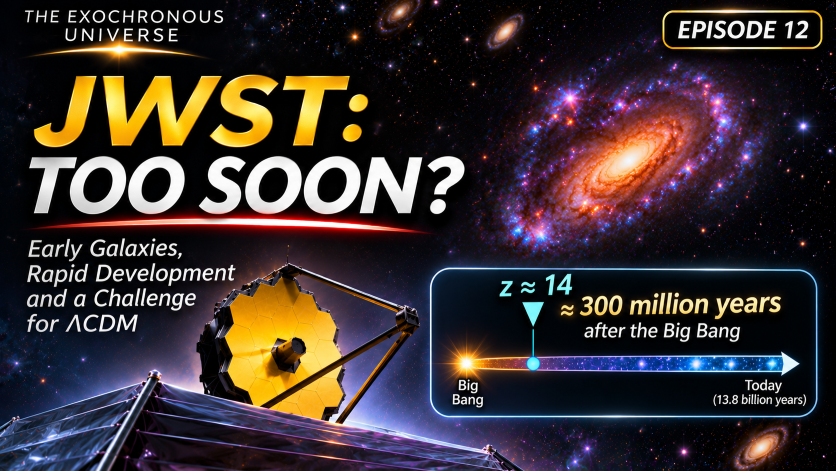
Episode 12 – The Cracks in Modern Cosmology — What JWST Is Revealing
The James Webb Space Telescope is revealing galaxies that appear remarkably luminous, chemically enriched and developed just a few hundred million years after the Big Bang. Did the early Universe really have enough time to produce them? In Episode 12 of The Exochronous Universe, we bring together some of the most significant unresolved questions in…
-
Episode 11 – Dark Energy: Why Is the Universe Accelerating?
What measurements led astronomers to conclude that the Universe’s expansion is accelerating—and how much do they tell us about dark energy? In Episode 11 of The Exochronous Universe, we follow the evidence from supernova brightness and redshift to luminosity distance, reconstructed expansion histories, and the cosmological constant, Λ. We examine:• How Type Ia supernovae became…
-
Episode 10 – Dark Matter: The Invisible Architecture of the Universe
What do we actually observe that leads cosmologists to infer dark matter—and how far does the evidence take us towards identifying what it is? From the unexpectedly rapid orbital motion of stars in galaxies to gravitational lensing, colliding galaxy clusters, the Cosmic Microwave Background and the formation of the cosmic web, several substantially independent observations…
-
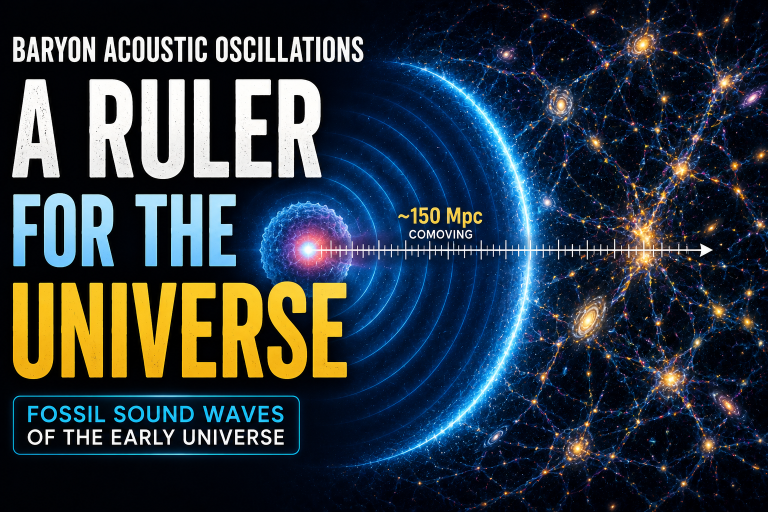
Episode 9 — Baryon Acoustic Oscillations: Fossil Sound Waves of the Early Universe
Baryon Acoustic Oscillations, or BAO, are the fossil imprint of sound waves that traveled through the early Universe more than 13 billion years ago. Today, their characteristic scale can still be detected statistically in the distribution of galaxies — providing cosmologists with one of their most important “standard rulers”. Before atoms formed, ordinary matter and…
-
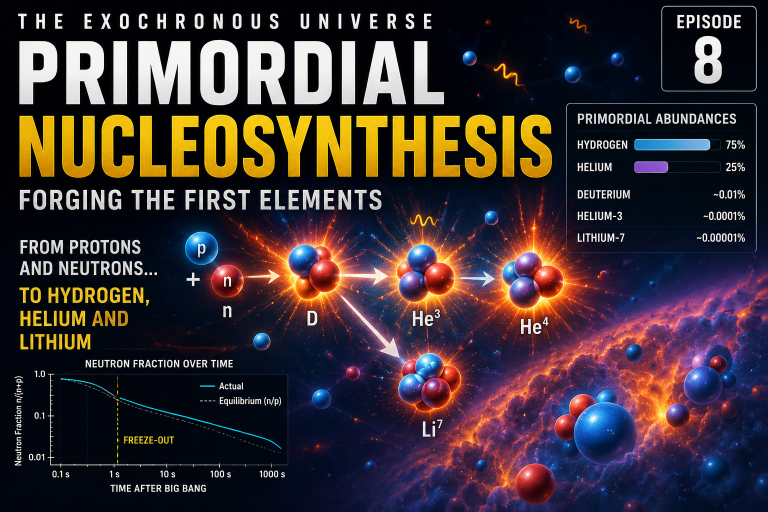
Episode 8 – Primordial Nucleosynthesis: Forging the First Elements
In the first few minutes of cosmic history, the Universe became a nuclear furnace. Protons and neutrons combined to form the first atomic nuclei: deuterium, helium-3, helium-4 and tiny traces of lithium-7. But this process could only begin once the Universe had cooled enough for fragile deuterium nuclei to survive — and it lasted for…
-
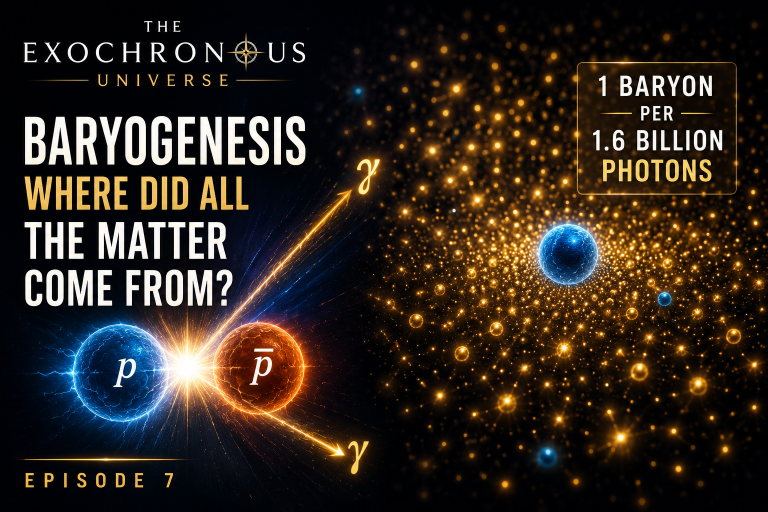
Episode 7 – Baryogenesis: Where Did All the Matter Come From?
Everything around us—every star, every planet, every living thing—is made from ordinary matter. But according to modern particle physics, the extremely hot conditions believed to have existed in the early Universe should have produced matter and antimatter in almost equal quantities. If so, why wasn’t everything annihilated? In this episode, we explore one of the…
-
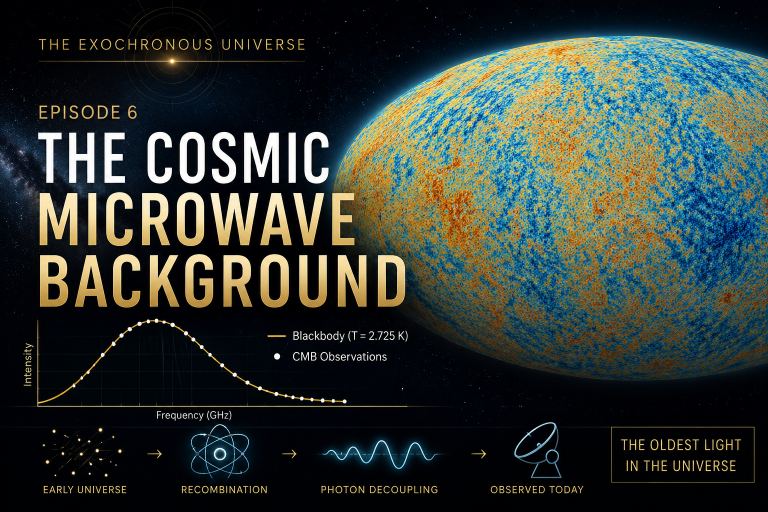
Episode 6 – The Cosmic Microwave Background
The Cosmic Microwave Background is often described as the oldest light in the Universe. But what do we actually observe—and what do we infer from those observations? In this episode of The Exochronous Universe, we explore one of the most important discoveries in modern cosmology: the Cosmic Microwave Background (CMB). We begin with its accidental…
-
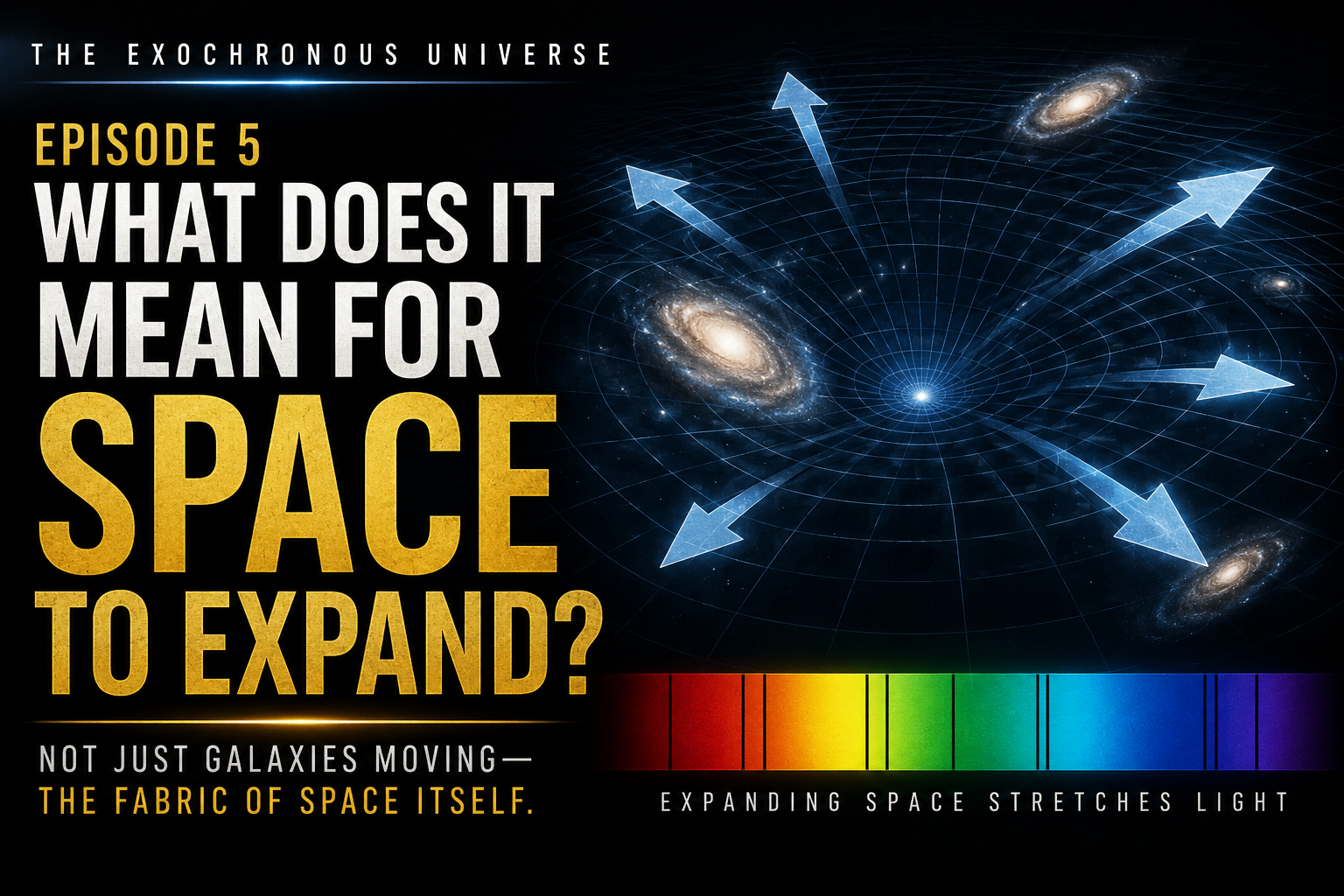
Episode 5 – What Does It Mean for Space to Expand?
What does it actually mean to say that the Universe is expanding? Modern cosmology tells us that distant galaxies are receding from one another as space itself expands. But what does that statement really mean? Are galaxies moving through space, or is the geometry of space changing? Why can some galaxies appear to recede faster…
-
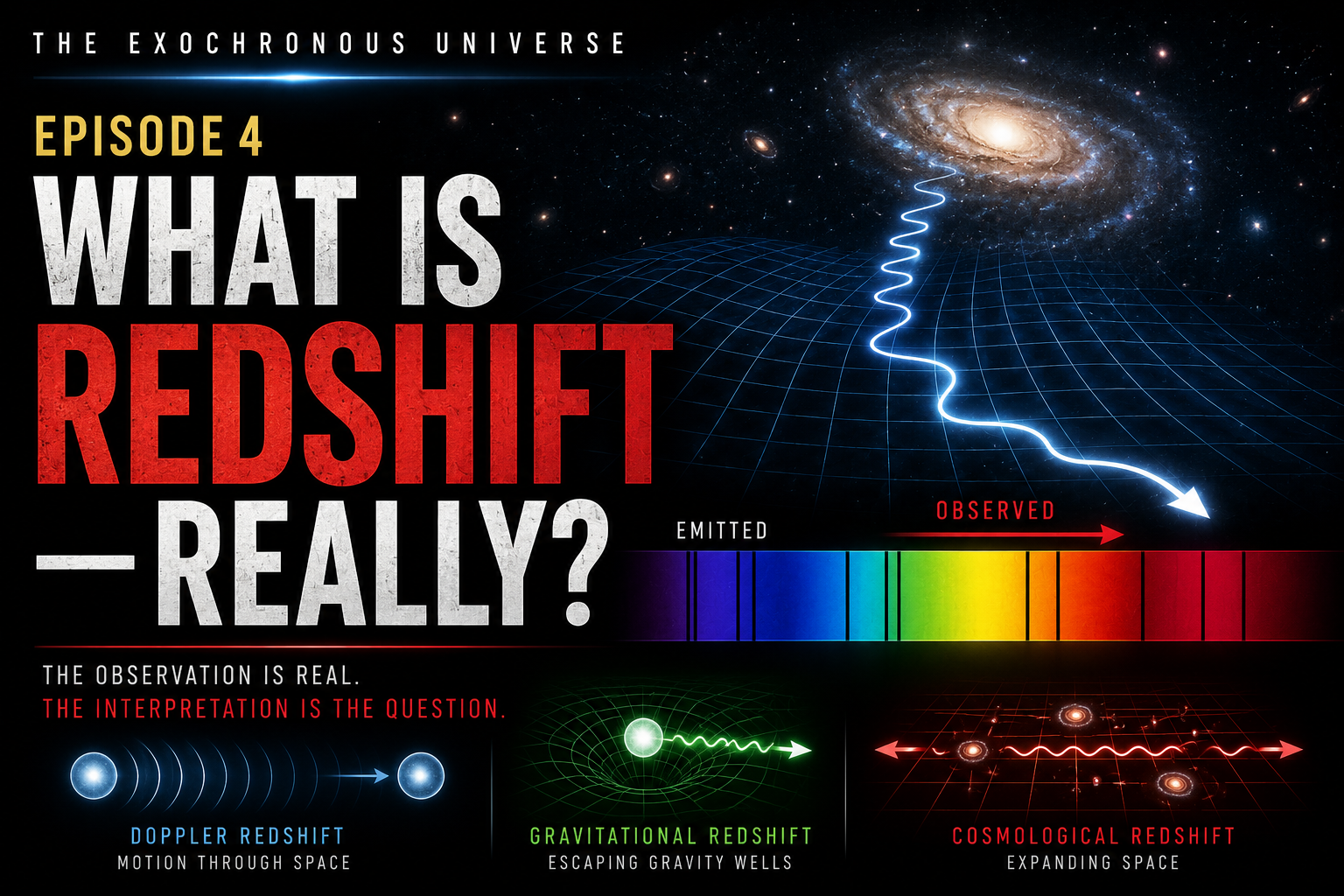
Episode 4 – What is Redshift – Really?
For more than a century, cosmic redshift has been one of the foundational observations of modern cosmology. It underpins our understanding of an expanding universe, the Big Bang, and the history of cosmic evolution itself. But what exactly is redshift? What do astronomers actually measure when they observe distant galaxies? How are redshifts determined from…
-
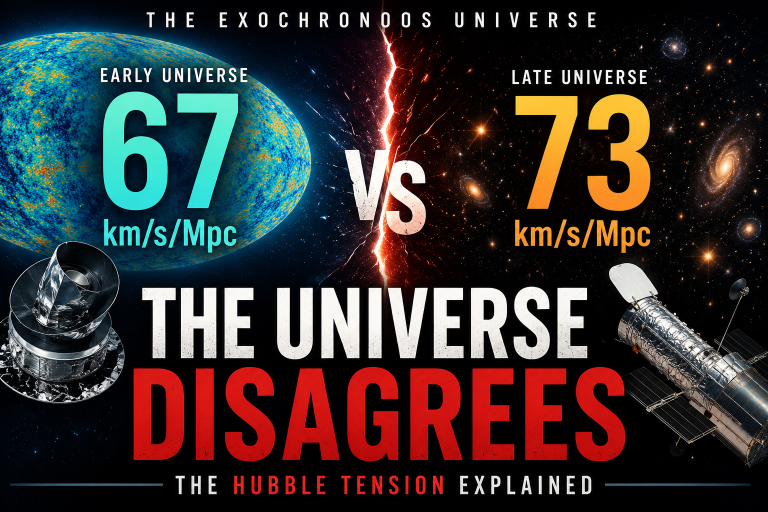
Episode 3 – The Hubble Tension Explained
The Universe appears to disagree with itself. Using observations of the early Universe, cosmologists derive one value for the Hubble constant — the rate at which the cosmos is expanding today. But measurements based on nearby galaxies give a different answer. This growing discrepancy, known as the Hubble tension, has become one of the most…