
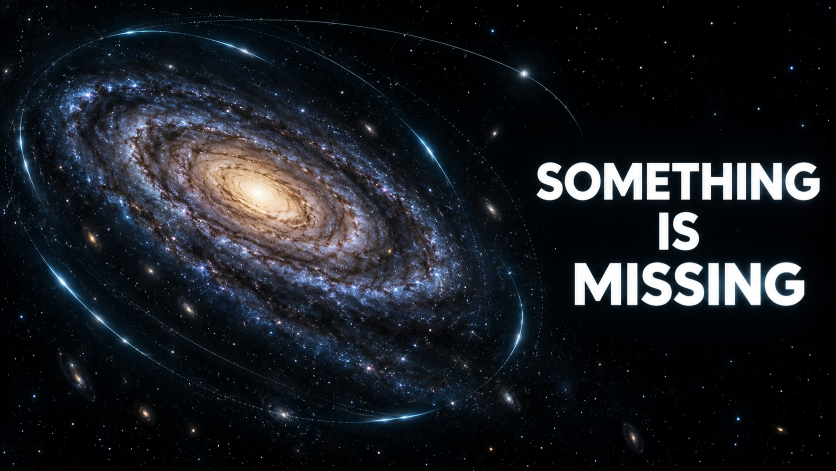
What do we actually observe that leads cosmologists to infer dark matter—and how far does the evidence take us towards identifying what it is?
From the unexpectedly rapid orbital motion of stars in galaxies to gravitational lensing, colliding galaxy clusters, the Cosmic Microwave Background and the formation of the cosmic web, several substantially independent observations point towards a recurring gravitational discrepancy: the Universe appears to contain considerably more gravitating matter than the baryonic matter we can observe.
In this episode of The Exochronous Universe, we examine the cumulative case for dark matter across multiple physical scales:
• the historical missing-mass problem in galaxy clusters;
• the flat rotation curves of spiral galaxies;
• gravitational lensing and reconstructed cluster mass distributions;
• the separation of hot gas and inferred mass in merging clusters such as the Bullet Cluster;
• constraints on baryonic matter from primordial nucleosynthesis;
• the acoustic structure of the Cosmic Microwave Background;
• N-body simulations and the growth of galaxies, clusters and the cosmic web;
• the properties required of a viable dark-matter candidate;
• direct, indirect and collider searches for dark-matter particles;
• and the alternative possibility that our description of gravity may be incomplete.
The observations strongly establish the gravitational phenomena attributed to dark matter. Within ΛCDM, a cold, predominantly non-baryonic component provides a remarkably successful common explanation. But that conclusion is not identical to identifying a particular particle—and despite increasingly sensitive searches, the microscopic nature of dark matter remains unknown.
References/Further Reading
Historical origin and galaxy clusters
- Zwicky, F. (1937). “On the Masses of Nebulae and of Clusters of Nebulae.”
The Astrophysical Journal, 86, 217–246.
DOI: 10.1086/143864
Zwicky’s developed English-language treatment of the Coma Cluster mass discrepancy and application of the virial theorem. - Andernach, H. & Zwicky, F. (2017). “English and Spanish Translation of Zwicky’s (1933) ‘The Redshift of Extragalactic Nebulae’.”
arXiv:1711.01693
A useful translation of the original 1933 paper in which Zwicky introduced the phrase dunkle Materie in connection with the Coma Cluster.
Galaxy rotation curves
- Rubin, V. C., Ford, W. K. Jr. & Thonnard, N. (1980). “Rotational Properties of 21 Sc Galaxies with a Large Range of Luminosities and Radii.”
The Astrophysical Journal, 238, 471–487.
DOI: 10.1086/158003
One of the landmark observational studies establishing that extended galaxy rotation curves commonly remain flat rather than declining as expected from the luminous distribution alone. - Lelli, F., McGaugh, S. S. & Schombert, J. M. (2016). “SPARC: Mass Models for 175 Disk Galaxies with Spitzer Photometry and Accurate Rotation Curves.”
The Astronomical Journal, 152, 157.
DOI: 10.3847/0004-6256/152/6/157 · arXiv:1606.09251
A modern, publicly available collection of high-quality rotation curves and baryonic mass models for 175 galaxies.
Gravitational lensing and merging clusters
- Bartelmann, M. & Schneider, P. (2001). “Weak Gravitational Lensing.”
Physics Reports, 340, 291–472.
DOI: 10.1016/S0370-1573(00)00082-X · arXiv:astro-ph/9912508
A comprehensive account of the theory and observational use of weak lensing, including reconstruction of cluster and large-scale mass distributions. - Clowe, D. et al. (2006). “A Direct Empirical Proof of the Existence of Dark Matter.”
The Astrophysical Journal Letters, 648, L109–L113.
DOI: 10.1086/508162 · arXiv:astro-ph/0608407
The landmark Bullet Cluster lensing analysis showing the spatial separation between the dominant lensing mass and the X-ray-emitting baryonic gas. The episode appropriately uses more cautious language than the paper’s title.
Baryon density and the Cosmic Microwave Background
- Fields, B. D., Olive, K. A., Yeh, T.-H. & Young, C. (2020). “Big-Bang Nucleosynthesis after Planck.”
Journal of Cosmology and Astroparticle Physics, 2020(03), 010.
DOI: 10.1088/1475-7516/2020/03/010 · arXiv:1912.01132
A detailed assessment of primordial nucleosynthesis, light-element abundances and the independently constrained cosmic baryon density. - Planck Collaboration (2020). “Planck 2018 Results. VI. Cosmological Parameters.”
Astronomy & Astrophysics, 641, A6.
DOI: 10.1051/0004-6361/201833910 · arXiv:1807.06209
The principal source for the CMB-derived baryon, cold-dark-matter and total-matter density parameters used in the episode.
Structure formation and N-body simulations
- Springel, V. et al. (2005). “Simulations of the Formation, Evolution and Clustering of Galaxies and Quasars.”
Nature, 435, 629–636.
DOI: 10.1038/nature03597 · arXiv:astro-ph/0504097
The Millennium Simulation paper: a landmark demonstration of hierarchical structure formation in a ΛCDM cosmology and comparison with observed galaxy clustering. - Angulo, R. E. & Hahn, O. (2022). “Large-scale Dark Matter Simulations.”
Living Reviews in Computational Astrophysics, 8, 1.
DOI: 10.1007/s41115-021-00013-z
A modern review of collisionless N-body simulations, their physical foundations, numerical methods and role in predicting large-scale structure.
Particle candidates and experimental searches
- Bertone, G., Hooper, D. & Silk, J. (2005). “Particle Dark Matter: Evidence, Candidates and Constraints.”
Physics Reports, 405, 279–390.
DOI: 10.1016/j.physrep.2004.08.031 · arXiv:hep-ph/0404175
A major review connecting the astrophysical evidence with particle candidates and direct and indirect detection strategies. Some candidate emphasis reflects the period in which it was written, but its conceptual survey remains valuable. - Particle Data Group (2025). “Dark Matter.”
In Review of Particle Physics.
PDG Dark Matter Review
The most useful current technical overview of cosmological constraints, candidate classes and laboratory, collider and astrophysical searches.
Modified-gravity context
- Milgrom, M. (1983). “A Modification of the Newtonian Dynamics as a Possible Alternative to the Hidden Mass Hypothesis.”
The Astrophysical Journal, 270, 365–370.
DOI: 10.1086/161130
The foundational MOND paper proposing modified low-acceleration dynamics as an alternative interpretation of galactic mass discrepancies. - Famaey, B. & McGaugh, S. S. (2012). “Modified Newtonian Dynamics (MOND): Observational Phenomenology and Relativistic Extensions.”
Living Reviews in Relativity, 15, 10.
DOI: 10.12942/lrr-2012-10
A thorough review of MOND’s galaxy-scale successes, theoretical formulations and difficulties on cluster and cosmological scales.
Leave a Reply