
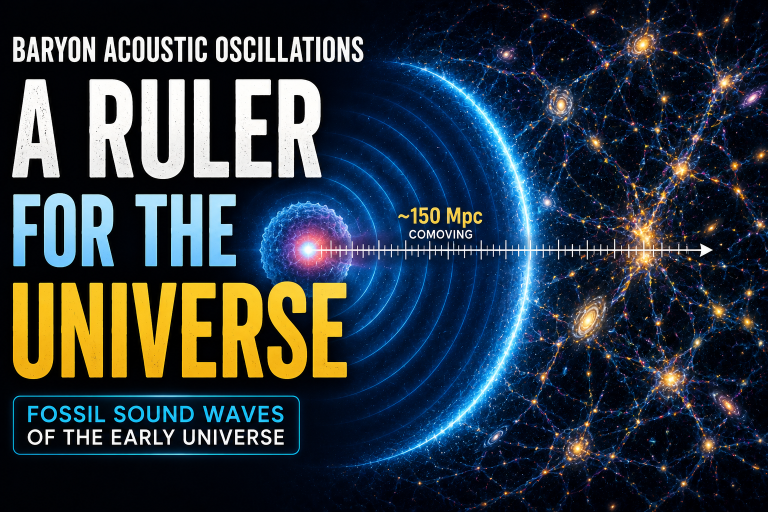
Baryon Acoustic Oscillations, or BAO, are the fossil imprint of sound waves that traveled through the early Universe more than 13 billion years ago. Today, their characteristic scale can still be detected statistically in the distribution of galaxies — providing cosmologists with one of their most important “standard rulers”.
Before atoms formed, ordinary matter and radiation existed as a hot, tightly coupled photon–baryon plasma. Tiny primordial variations in density were acted upon by two competing effects: gravity pulled matter inward, while radiation pressure resisted compression. The result was a system of acoustic waves propagating through the early Universe. When photons eventually decoupled from matter, this acoustic propagation came to an end, leaving behind a characteristic scale known as the sound horizon. But we do not see enormous acoustic shells surrounding individual galaxies today. Instead, the imprint survives as something much subtler: a small statistical excess in the probability of finding pairs of galaxies separated by roughly 150 megaparsecs in comoving distance.
In Episode 9 of The Exochronous Universe, we explore:
- why the primordial photon–baryon plasma could support sound waves
- the competition between gravity and radiation pressure
- how acoustic disturbances propagated through the early Universe
- the origin of the cosmological sound horizon
- what happened when photons and matter decoupled
- how the primordial acoustic scale survived billions of years of structure formation
- why BAO are detected statistically rather than as visible shells around galaxies
- the galaxy two-point correlation function and its characteristic BAO peak
- the corresponding BAO “wiggles” in the matter power spectrum
- how the acoustic scale becomes a cosmological standard ruler
- how transverse and radial BAO measurements probe cosmic distances and expansion history
- the close relationship between BAO and the acoustic physics of the Cosmic Microwave Background
As throughout this series, we distinguish carefully between what astronomers directly observe, what is extracted statistically from those observations, and what depends upon physical modelling and cosmological assumptions. BAO provide a remarkable connection between two very different epochs: pressure waves in the primordial plasma and the distribution of galaxies billions of years later. Their explanation also introduces another important component of the cosmological model — matter that contributed gravity to the primordial density perturbations but did not interact with radiation in the same way as ordinary matter.
References / Further Reading
Eisenstein & Hu (1998), Baryonic Features in the Matter Transfer Function, ApJ 496, 605.
Eisenstein et al. (2005), Detection of the Baryon Acoustic Peak in the Large-Scale Correlation Function of SDSS Luminous Red Galaxies, ApJ 633, 560.
Cole et al. (2005), The 2dF Galaxy Redshift Survey: Power-spectrum analysis of the final dataset and cosmological implications, MNRAS 362, 505.
Percival et al. (2007), Measuring the Baryon Acoustic Oscillation scale using the Sloan Digital Sky Survey and 2dF Galaxy Redshift Survey, MNRAS 381, 1053.
Bassett & Hlozek (2010), Baryon Acoustic Oscillations, arXiv:0910.5224. DESI Collaboration (2025), DESI 2024 VI: Cosmological Constraints from the Measurements of Baryon Acoustic Oscillations, JCAP 02, 021.
Leave a Reply