
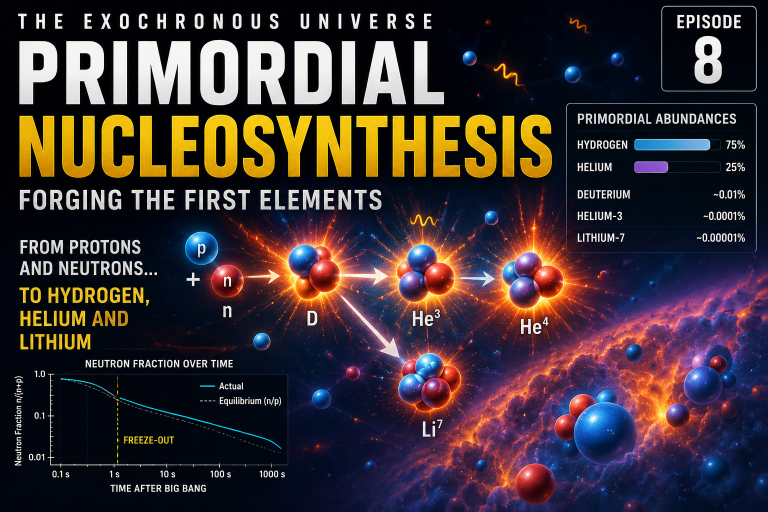
In the first few minutes of cosmic history, the Universe became a nuclear furnace.
Protons and neutrons combined to form the first atomic nuclei: deuterium, helium-3, helium-4 and tiny traces of lithium-7. But this process could only begin once the Universe had cooled enough for fragile deuterium nuclei to survive — and it lasted for only a matter of minutes.
In Episode 8 of The Exochronous Universe, we explore Primordial Nucleosynthesis: Forging the First Elements.
We examine:
• how the early proton-to-neutron ratio was established
• why free neutrons gradually disappeared through beta decay
• the “deuterium bottleneck” that initially prevented nuclear fusion
• how deuterium, helium-3 and helium-4 were produced
• why primordial nucleosynthesis eventually came to an end
• how the predicted abundances of the light elements are calculated
• how astronomers attempt to measure their primordial abundances today
• why deuterium and helium provide a remarkable quantitative test of Big Bang cosmology
• and the continuing puzzle of lithium-7
Unlike many aspects of early-universe cosmology, primordial nucleosynthesis is tightly constrained by laboratory nuclear physics. Many of the relevant nuclear reaction rates have been measured experimentally, allowing detailed numerical calculations to make predictions that can be compared directly with astronomical observations.
The resulting agreement — particularly for deuterium and helium — is one of the major successes of the standard cosmological model.
But the agreement is not perfect. The observed abundance of lithium-7 remains significantly below the standard prediction, producing the long-standing cosmological lithium problem.
Primordial nucleosynthesis therefore provides an important example of how cosmology works at its strongest: astronomical observations, experimentally tested physics and numerical modelling coming together to produce quantitative predictions.
And it establishes an important standard for any alternative description of cosmic history.
Whatever model ultimately describes the Universe must explain not only its galaxies, redshifts and microwave background, but also why the first few minutes produced exactly the mixture of light elements that we observe today.
The Exochronous Universe explores the observational foundations of modern cosmology, the assumptions used to interpret them, the tensions within the standard model, and eventually the possibility of alternative ways of understanding the Universe.
Leave a Reply