
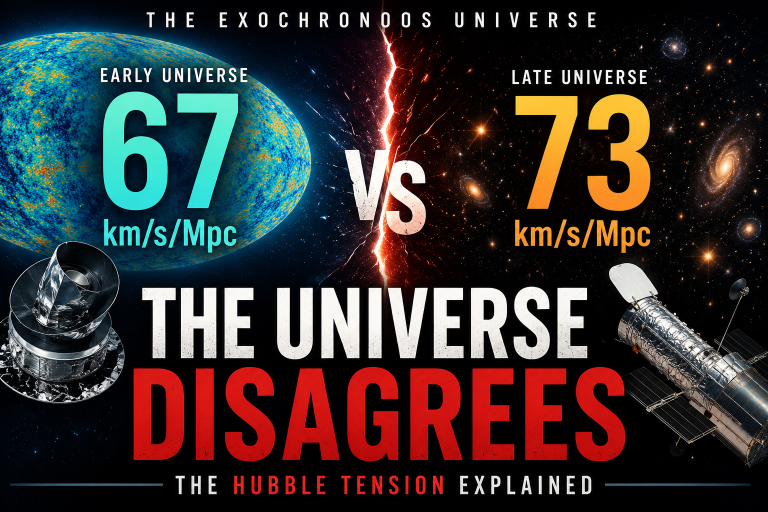
The Universe appears to disagree with itself.
Using observations of the early Universe, cosmologists derive one value for the Hubble constant — the rate at which the cosmos is expanding today.
But measurements based on nearby galaxies give a different answer.
This growing discrepancy, known as the Hubble tension, has become one of the most significant unresolved problems in modern cosmology.
In this episode, we explore:
- What the Hubble constant actually measures
- How astronomers use redshift to infer cosmic expansion
- Why measurements from the Cosmic Microwave Background differ from direct observations of galaxies
- How primordial sound waves in the early Universe influence modern cosmological models
- And why the tension may point toward deeper questions about the nature of cosmic measurement itself
Rather than offering easy answers, this episode examines the assumptions underlying modern cosmology — and asks whether the disagreement could reflect something more fundamental about how we interpret the Universe.
Leave a Reply