
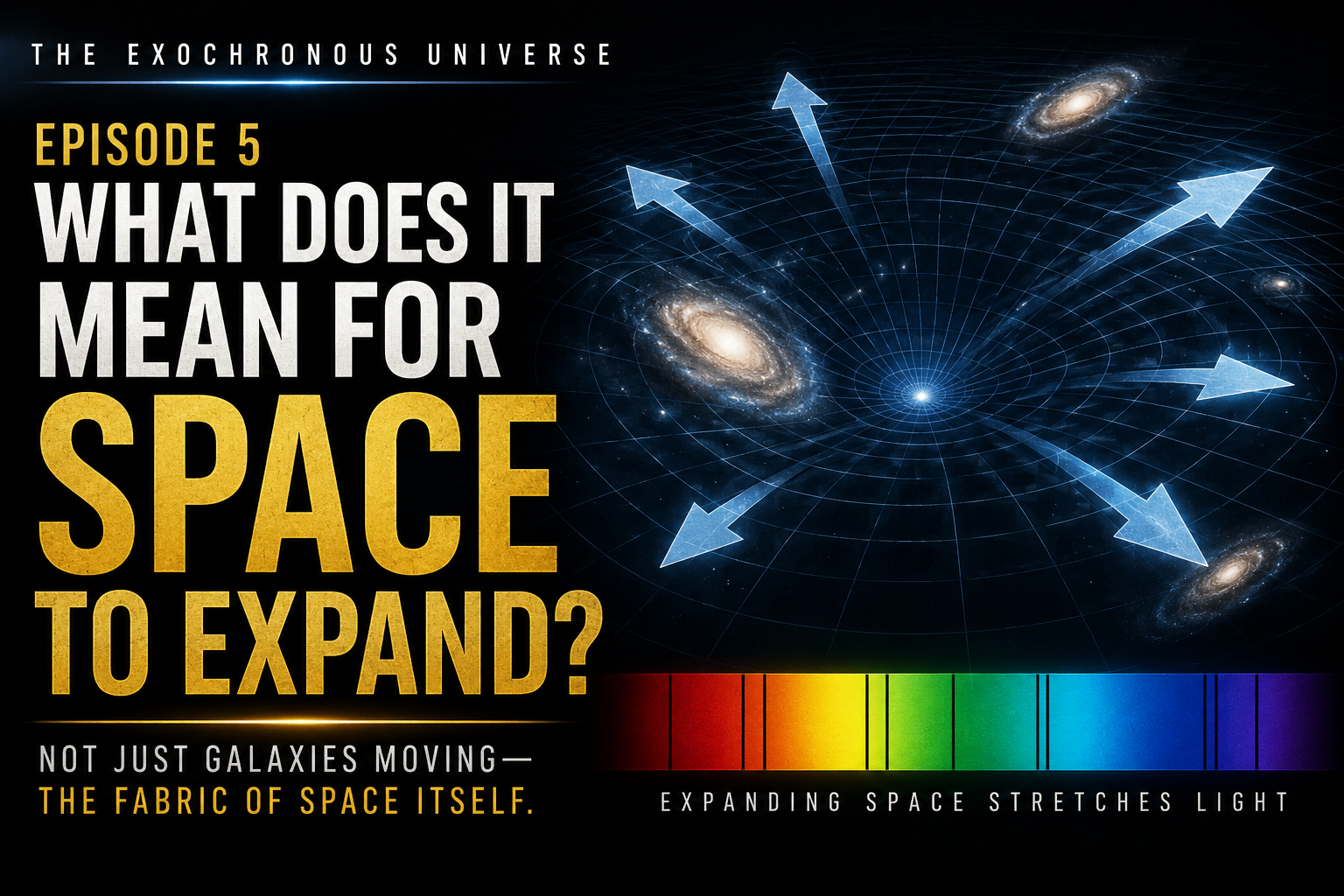
What does it actually mean to say that the Universe is expanding?
Modern cosmology tells us that distant galaxies are receding from one another as space itself expands. But what does that statement really mean? Are galaxies moving through space, or is the geometry of space changing? Why can some galaxies appear to recede faster than light? And if space is expanding, why don’t stars, planets, or even atoms expand as well?
In this episode of The Exochronous Universe, we explore one of the most fundamental—and often misunderstood—concepts in cosmology: the expansion of space.
We’ll examine:
- The difference between motion through space and expansion of space
- The role of the cosmological scale factor • Comoving coordinates and cosmic geometry
- Why distant galaxies can appear to recede faster than light
- Why gravitationally bound structures do not participate in cosmic expansion
- The strengths and limitations of common analogies such as the balloon, raisin bread, and rubber sheet models
- The distinction between direct observation and geometric interpretation
Along the way, we’ll revisit a recurring theme of this series: the difference between what astronomers directly observe and the theoretical frameworks used to interpret those observations.
This episode does not advocate any particular cosmological model. Instead, it aims to clarify what modern cosmologists mean when they describe an expanding Universe—and to encourage careful thinking about the assumptions that underlie our interpretation of the cosmos.
Leave a Reply