The Exochronous Universe

Modern cosmology rests on the remarkable success of the ΛCDM model — a framework that describes a universe dominated by dark matter, dark energy, and an early inflationary epoch.
But as observational precision increases, so too do the tensions.
The Exochronous Universe is a series exploring cosmology from first principles.

We examine:

And we ask:

Is it possible to describe these phenomena more economically — without inflation, dark matter, or dark energy?

This channel presents a rigorous, open, and evidence-driven exploration of an alternative framework based on the Jeans Contraction hypothesis and the Exochronous (timeless) metric.


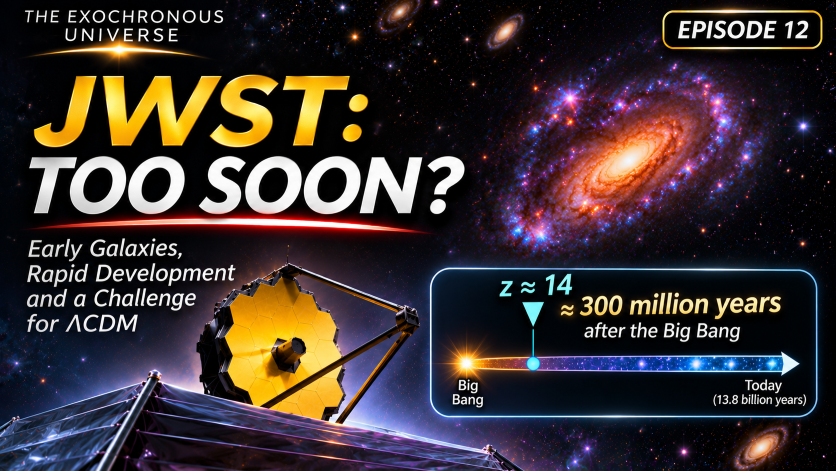
  • Episode 12 – The Cracks in Modern Cosmology — What JWST Is Revealing

    The James Webb Space Telescope is revealing galaxies that appear remarkably luminous, chemically enriched and developed just a few hundred million years after the Big Bang.

    Did the early Universe really have enough time to produce them?

    In Episode 12 of The Exochronous Universe, we bring together some of the most significant unresolved questions in modern cosmology — from the Hubble tension and the mysteries of dark matter and dark energy to the extraordinary discoveries emerging from JWST.

    We also investigate a less widely discussed observation: the relationship between galaxy angular size and redshift.

    Using data from six independent JWST survey fields, we examine how the inferred physical sizes of distant galaxies depend on the cosmological distance model used to interpret their observations.

    Under the standard ΛCDM model, our analysis finds that inferred galaxy half-light radii decrease approximately as (1+z)⁻¹ at redshifts greater than two. An alternative static-universe distance prescription produces a much flatter size evolution.

    Does this mean the Universe is not expanding? Not necessarily. Galaxies evolve, and their observed sizes are affected by selection effects and instrumental limitations. But the comparison illustrates an important distinction between what astronomers actually measure and what cosmological models allow us to infer.

    In this episode:

    • Why the Hubble tension remains unresolved.
    • What JWST is revealing about early galaxies, chemical enrichment and supermassive black holes.
    • Why early galaxy formation presents challenges for conventional astrophysical models.
    • How astronomers measure the apparent sizes of distant galaxies.
    • What our independent analysis of six JWST survey fields reveals.
    • Why inferred galaxy sizes and cosmic ages depend on cosmological assumptions.
    • Whether alternative interpretations of cosmological redshift deserve further investigation.

    ΛCDM remains a remarkably successful framework, accounting for the cosmic microwave background, large-scale structure and many other observations. The questions explored here do not invalidate those achievements.

    But they invite us to reconsider the distinction between observation, mathematical description and physical explanation.

    What if cosmological redshift has an explanation beyond the expansion of space?

    That is the question we will begin exploring in Episode 13:

    What If the Universe Isn’t Expanding? — Jeans Contraction and the Origin of Cosmological Redshift.


    Scientific references

    1. Planck Collaboration (2020). Planck 2018 Results. VI. Cosmological Parameters. Astronomy & Astrophysics.
      https://doi.org/10.1051/0004-6361/201833910
    2. Riess et al. (2022). A Comprehensive Measurement of the Local Value of the Hubble Constant. Astrophysical Journal Letters.
      https://doi.org/10.3847/2041-8213/ac5c5b
    3. Carniani et al. (2024). A shining cosmic dawn: spectroscopic confirmation of two luminous galaxies at z ~ 14. Nature.
      https://doi.org/10.1038/s41586-024-07860-9
    4. Schouws et al. (2025). The surprisingly mature galaxy JADES-GS-z14-0 at redshift 14.18. Nature.
      https://doi.org/10.1038/s41586-024-08402-5
    5. Lovyagin et al. (2022). Cosmological Model Tests with JWST. Galaxies, 10, 108.
      https://doi.org/10.3390/galaxies10060108
    6. Raikov, Tsymbal & Lovyagin (2025). Cosmological Observational Tests in the JWST Era. I: Angular Size–Redshift. Astrophysical Bulletin.
      https://doi.org/10.1134/S1990341325600383

    Galaxy-size analysis: Independent examination of spectroscopically confirmed galaxies from six ASTRODEEP-JWST survey fields (CEERS, Abell 2744, PRIMER-UDS, PRIMER-COSMOS, JADES-GS and JADES-GN). The full selected catalogue contains 7,056 galaxies; size-evolution fits use the subset at z > 2.

    ASTRODEEP-JWST catalogues:
    http://www.astrodeep.eu/astrodeep-jwst-catalogs/


    Join the discussion

    Do JWST’s discoveries primarily challenge our models of early galaxy formation, or should we also reconsider some of the cosmological assumptions used to interpret them?

    Comments and scientifically grounded alternative perspectives are welcome.

    Subscribe to The Exochronous Universe for the next episode, where we begin exploring Jeans Contraction as a possible alternative explanation for cosmological redshift.

    #JWST #Cosmology #LambdaCDM #JamesWebbSpaceTelescope #HubbleTension #Redshift #ExochronousUniverse

  • Episode 11 – Dark Energy: Why Is the Universe Accelerating?

    What measurements led astronomers to conclude that the Universe’s expansion is accelerating—and how much do they tell us about dark energy?

    In Episode 11 of The Exochronous Universe, we follow the evidence from supernova brightness and redshift to luminosity distance, reconstructed expansion histories, and the cosmological constant, Λ.

    We examine:
    • How Type Ia supernovae became standardisable distance indicators.
    • Why the 1998–99 supernova results favoured accelerated expansion.
    • Why Einstein introduced Λ long before those observations.
    • How the cosmic microwave background and baryon acoustic oscillations strengthen the cosmological tests.
    • The vacuum-energy and cosmic coincidence problems.
    • What DESI’s results suggest about whether dark energy is constant.
    • How structure growth provides another test of the interpretation.

    Throughout, we distinguish what astronomers observe from what they infer through physical models. ΛCDM describes a wide range of measurements successfully, but the physical origin of dark energy remains unresolved.

    The DESI discussion reflects results available as of October 2026.

    References / Further Reading

    Riess, A. G., et al. (1998). “Observational Evidence from Supernovae for an Accelerating Universe and a Cosmological Constant.” The Astronomical Journal, 116, 1009–1038.
    The original High-Z Supernova Search Team discovery paper.
    Read paper. arxiv.org

    Perlmutter, S., et al. (1999). “Measurements of Ω and Λ from 42 High-Redshift Supernovae.” The Astrophysical Journal, 517, 565–586.
    The independent Supernova Cosmology Project result; particularly relevant to the distance–redshift model comparisons.
    Read paper. arxiv.org

    Brout, D., et al. (2022). “The Pantheon+ Analysis: Cosmological Constraints.”
    A modern supernova analysis with improved treatment of systematic uncertainties and combined constraints from supernovae, CMB and BAO.
    Read paper. arxiv.org

    Planck Collaboration (2020). “Planck 2018 Results. VI. Cosmological Parameters.” Astronomy & Astrophysics, 641, A6.
    The reference for the base-ΛCDM parameter estimates and the contribution of CMB measurements to cosmological inference.
    Read paper. arxiv.org

    Carroll, S. M. (2001). “The Cosmological Constant.”
    A useful pedagogical review linking Λ, its cosmological effects and the vacuum-energy problem.
    Read paper. arxiv.org

    Weinberg, S. (1989). “The Cosmological Constant Problem.” Reviews of Modern Physics, 61, 1–23.
    The classic theoretical reference for the difficulty of explaining the small cosmological value of vacuum energy.
    Publisher page. Rev. Mod. Phys.

    DESI Collaboration (2025). “DESI DR2 Results II: Measurements of Baryon Acoustic Oscillations and Cosmological Constraints.”
    The primary source for the evolving-dark-energy preference in combinations of DESI, CMB and supernova data, including its dependence on the supernova sample.
    Read paper. arxiv.org

    DESI Collaboration (2026). “DESI DR2 Results IV: Alcock-Paczyński Measurements from the Lyman Alpha Forest and Cosmological Constraints.”
    The July 2026 analysis discussed in the episode; include it alongside the 2025 paper to represent the subsequent development fairly.
    Read paper.


  • Episode 10 – Dark Matter: The Invisible Architecture of the Universe

    What do we actually observe that leads cosmologists to infer dark matter—and how far does the evidence take us towards identifying what it is?

    From the unexpectedly rapid orbital motion of stars in galaxies to gravitational lensing, colliding galaxy clusters, the Cosmic Microwave Background and the formation of the cosmic web, several substantially independent observations point towards a recurring gravitational discrepancy: the Universe appears to contain considerably more gravitating matter than the baryonic matter we can observe.

    In this episode of The Exochronous Universe, we examine the cumulative case for dark matter across multiple physical scales:

    • the historical missing-mass problem in galaxy clusters;
    • the flat rotation curves of spiral galaxies;
    • gravitational lensing and reconstructed cluster mass distributions;
    • the separation of hot gas and inferred mass in merging clusters such as the Bullet Cluster;
    • constraints on baryonic matter from primordial nucleosynthesis;
    • the acoustic structure of the Cosmic Microwave Background;
    • N-body simulations and the growth of galaxies, clusters and the cosmic web;
    • the properties required of a viable dark-matter candidate;
    • direct, indirect and collider searches for dark-matter particles;
    • and the alternative possibility that our description of gravity may be incomplete.

    The observations strongly establish the gravitational phenomena attributed to dark matter. Within ΛCDM, a cold, predominantly non-baryonic component provides a remarkably successful common explanation. But that conclusion is not identical to identifying a particular particle—and despite increasingly sensitive searches, the microscopic nature of dark matter remains unknown.

    References/Further Reading

    Historical origin and galaxy clusters

    1. Zwicky, F. (1937). “On the Masses of Nebulae and of Clusters of Nebulae.”
      The Astrophysical Journal, 86, 217–246.
      DOI: 10.1086/143864
      Zwicky’s developed English-language treatment of the Coma Cluster mass discrepancy and application of the virial theorem.
    2. Andernach, H. & Zwicky, F. (2017). “English and Spanish Translation of Zwicky’s (1933) ‘The Redshift of Extragalactic Nebulae’.”
      arXiv:1711.01693
      A useful translation of the original 1933 paper in which Zwicky introduced the phrase dunkle Materie in connection with the Coma Cluster.

    Galaxy rotation curves

    1. Rubin, V. C., Ford, W. K. Jr. & Thonnard, N. (1980). “Rotational Properties of 21 Sc Galaxies with a Large Range of Luminosities and Radii.”
      The Astrophysical Journal, 238, 471–487.
      DOI: 10.1086/158003
      One of the landmark observational studies establishing that extended galaxy rotation curves commonly remain flat rather than declining as expected from the luminous distribution alone.
    2. Lelli, F., McGaugh, S. S. & Schombert, J. M. (2016). “SPARC: Mass Models for 175 Disk Galaxies with Spitzer Photometry and Accurate Rotation Curves.”
      The Astronomical Journal, 152, 157.
      DOI: 10.3847/0004-6256/152/6/157 · arXiv:1606.09251
      A modern, publicly available collection of high-quality rotation curves and baryonic mass models for 175 galaxies.

    Gravitational lensing and merging clusters

    1. Bartelmann, M. & Schneider, P. (2001). “Weak Gravitational Lensing.”
      Physics Reports, 340, 291–472.
      DOI: 10.1016/S0370-1573(00)00082-X · arXiv:astro-ph/9912508
      A comprehensive account of the theory and observational use of weak lensing, including reconstruction of cluster and large-scale mass distributions.
    2. Clowe, D. et al. (2006). “A Direct Empirical Proof of the Existence of Dark Matter.”
      The Astrophysical Journal Letters, 648, L109–L113.
      DOI: 10.1086/508162 · arXiv:astro-ph/0608407
      The landmark Bullet Cluster lensing analysis showing the spatial separation between the dominant lensing mass and the X-ray-emitting baryonic gas. The episode appropriately uses more cautious language than the paper’s title.

    Baryon density and the Cosmic Microwave Background

    1. Fields, B. D., Olive, K. A., Yeh, T.-H. & Young, C. (2020). “Big-Bang Nucleosynthesis after Planck.”
      Journal of Cosmology and Astroparticle Physics, 2020(03), 010.
      DOI: 10.1088/1475-7516/2020/03/010 · arXiv:1912.01132
      A detailed assessment of primordial nucleosynthesis, light-element abundances and the independently constrained cosmic baryon density.
    2. Planck Collaboration (2020). “Planck 2018 Results. VI. Cosmological Parameters.”
      Astronomy & Astrophysics, 641, A6.
      DOI: 10.1051/0004-6361/201833910 · arXiv:1807.06209
      The principal source for the CMB-derived baryon, cold-dark-matter and total-matter density parameters used in the episode.

    Structure formation and N-body simulations

    1. Springel, V. et al. (2005). “Simulations of the Formation, Evolution and Clustering of Galaxies and Quasars.”
      Nature, 435, 629–636.
      DOI: 10.1038/nature03597 · arXiv:astro-ph/0504097
      The Millennium Simulation paper: a landmark demonstration of hierarchical structure formation in a ΛCDM cosmology and comparison with observed galaxy clustering.
    2. Angulo, R. E. & Hahn, O. (2022). “Large-scale Dark Matter Simulations.”
      Living Reviews in Computational Astrophysics, 8, 1.
      DOI: 10.1007/s41115-021-00013-z
      A modern review of collisionless N-body simulations, their physical foundations, numerical methods and role in predicting large-scale structure.

    Particle candidates and experimental searches

    1. Bertone, G., Hooper, D. & Silk, J. (2005). “Particle Dark Matter: Evidence, Candidates and Constraints.”
      Physics Reports, 405, 279–390.
      DOI: 10.1016/j.physrep.2004.08.031 · arXiv:hep-ph/0404175
      A major review connecting the astrophysical evidence with particle candidates and direct and indirect detection strategies. Some candidate emphasis reflects the period in which it was written, but its conceptual survey remains valuable.
    2. Particle Data Group (2025). “Dark Matter.”
      In Review of Particle Physics.
      PDG Dark Matter Review
      The most useful current technical overview of cosmological constraints, candidate classes and laboratory, collider and astrophysical searches.

    Modified-gravity context

    1. Milgrom, M. (1983). “A Modification of the Newtonian Dynamics as a Possible Alternative to the Hidden Mass Hypothesis.”
      The Astrophysical Journal, 270, 365–370.
      DOI: 10.1086/161130
      The foundational MOND paper proposing modified low-acceleration dynamics as an alternative interpretation of galactic mass discrepancies.
    2. Famaey, B. & McGaugh, S. S. (2012). “Modified Newtonian Dynamics (MOND): Observational Phenomenology and Relativistic Extensions.”
      Living Reviews in Relativity, 15, 10.
      DOI: 10.12942/lrr-2012-10
      A thorough review of MOND’s galaxy-scale successes, theoretical formulations and difficulties on cluster and cosmological scales.


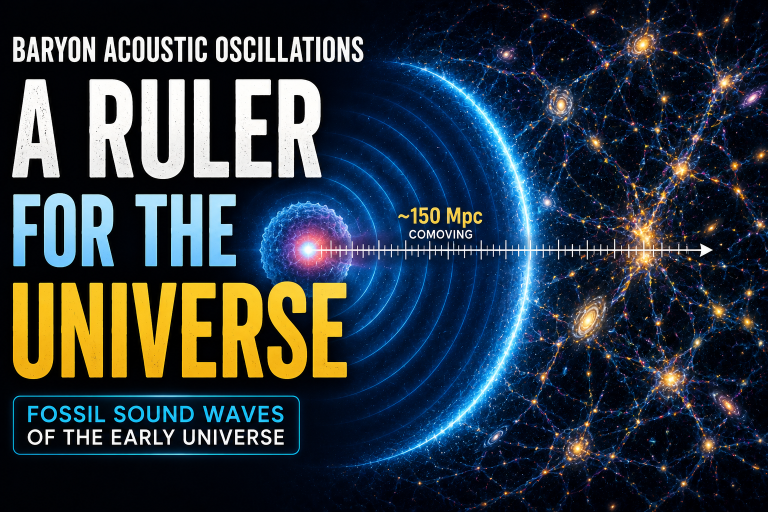
  • Episode 9 — Baryon Acoustic Oscillations: Fossil Sound Waves of the Early Universe

    Baryon Acoustic Oscillations, or BAO, are the fossil imprint of sound waves that traveled through the early Universe more than 13 billion years ago. Today, their characteristic scale can still be detected statistically in the distribution of galaxies — providing cosmologists with one of their most important “standard rulers”.

    Before atoms formed, ordinary matter and radiation existed as a hot, tightly coupled photon–baryon plasma. Tiny primordial variations in density were acted upon by two competing effects: gravity pulled matter inward, while radiation pressure resisted compression. The result was a system of acoustic waves propagating through the early Universe. When photons eventually decoupled from matter, this acoustic propagation came to an end, leaving behind a characteristic scale known as the sound horizon. But we do not see enormous acoustic shells surrounding individual galaxies today. Instead, the imprint survives as something much subtler: a small statistical excess in the probability of finding pairs of galaxies separated by roughly 150 megaparsecs in comoving distance.

    In Episode 9 of The Exochronous Universe, we explore:

    • why the primordial photon–baryon plasma could support sound waves
    • the competition between gravity and radiation pressure
    • how acoustic disturbances propagated through the early Universe
    • the origin of the cosmological sound horizon
    • what happened when photons and matter decoupled
    • how the primordial acoustic scale survived billions of years of structure formation
    • why BAO are detected statistically rather than as visible shells around galaxies
    • the galaxy two-point correlation function and its characteristic BAO peak
    • the corresponding BAO “wiggles” in the matter power spectrum
    • how the acoustic scale becomes a cosmological standard ruler
    • how transverse and radial BAO measurements probe cosmic distances and expansion history
    • the close relationship between BAO and the acoustic physics of the Cosmic Microwave Background

    As throughout this series, we distinguish carefully between what astronomers directly observe, what is extracted statistically from those observations, and what depends upon physical modelling and cosmological assumptions. BAO provide a remarkable connection between two very different epochs: pressure waves in the primordial plasma and the distribution of galaxies billions of years later. Their explanation also introduces another important component of the cosmological model — matter that contributed gravity to the primordial density perturbations but did not interact with radiation in the same way as ordinary matter.

    References / Further Reading

    Eisenstein & Hu (1998), Baryonic Features in the Matter Transfer Function, ApJ 496, 605.

    Eisenstein et al. (2005), Detection of the Baryon Acoustic Peak in the Large-Scale Correlation Function of SDSS Luminous Red Galaxies, ApJ 633, 560.

    Cole et al. (2005), The 2dF Galaxy Redshift Survey: Power-spectrum analysis of the final dataset and cosmological implications, MNRAS 362, 505.

    Percival et al. (2007), Measuring the Baryon Acoustic Oscillation scale using the Sloan Digital Sky Survey and 2dF Galaxy Redshift Survey, MNRAS 381, 1053.

    Bassett & Hlozek (2010), Baryon Acoustic Oscillations, arXiv:0910.5224. DESI Collaboration (2025), DESI 2024 VI: Cosmological Constraints from the Measurements of Baryon Acoustic Oscillations, JCAP 02, 021.


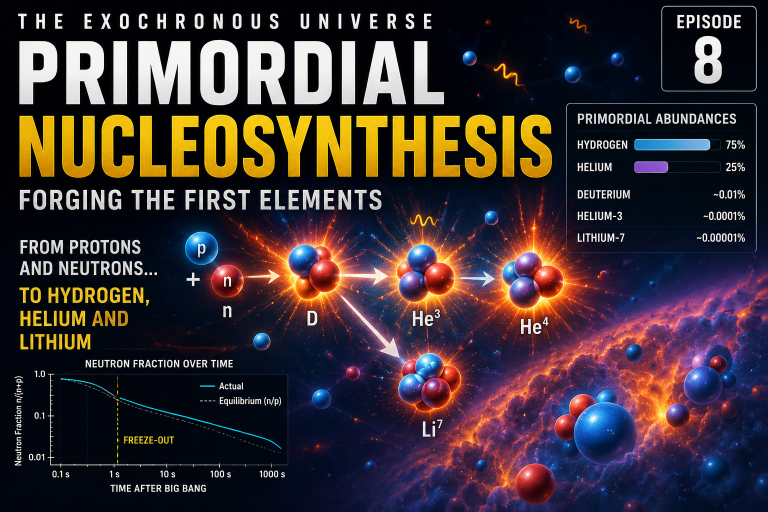
  • Episode 8 – Primordial Nucleosynthesis: Forging the First Elements

    In the first few minutes of cosmic history, the Universe became a nuclear furnace.

    Protons and neutrons combined to form the first atomic nuclei: deuterium, helium-3, helium-4 and tiny traces of lithium-7. But this process could only begin once the Universe had cooled enough for fragile deuterium nuclei to survive — and it lasted for only a matter of minutes.

    In Episode 8 of The Exochronous Universe, we explore Primordial Nucleosynthesis: Forging the First Elements.

    We examine:

    • how the early proton-to-neutron ratio was established
    • why free neutrons gradually disappeared through beta decay
    • the “deuterium bottleneck” that initially prevented nuclear fusion
    • how deuterium, helium-3 and helium-4 were produced
    • why primordial nucleosynthesis eventually came to an end
    • how the predicted abundances of the light elements are calculated
    • how astronomers attempt to measure their primordial abundances today
    • why deuterium and helium provide a remarkable quantitative test of Big Bang cosmology
    • and the continuing puzzle of lithium-7

    Unlike many aspects of early-universe cosmology, primordial nucleosynthesis is tightly constrained by laboratory nuclear physics. Many of the relevant nuclear reaction rates have been measured experimentally, allowing detailed numerical calculations to make predictions that can be compared directly with astronomical observations.

    The resulting agreement — particularly for deuterium and helium — is one of the major successes of the standard cosmological model.

    But the agreement is not perfect. The observed abundance of lithium-7 remains significantly below the standard prediction, producing the long-standing cosmological lithium problem.

    Primordial nucleosynthesis therefore provides an important example of how cosmology works at its strongest: astronomical observations, experimentally tested physics and numerical modelling coming together to produce quantitative predictions.

    And it establishes an important standard for any alternative description of cosmic history.

    Whatever model ultimately describes the Universe must explain not only its galaxies, redshifts and microwave background, but also why the first few minutes produced exactly the mixture of light elements that we observe today.

    The Exochronous Universe explores the observational foundations of modern cosmology, the assumptions used to interpret them, the tensions within the standard model, and eventually the possibility of alternative ways of understanding the Universe.


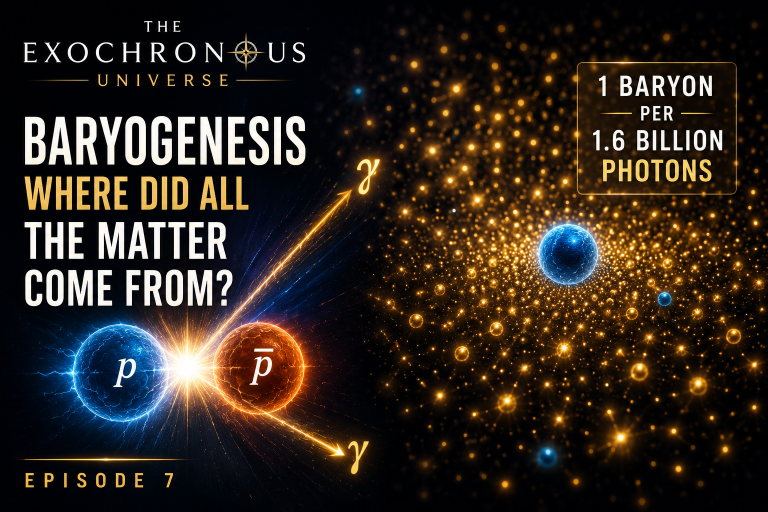
  • Episode 7 – Baryogenesis: Where Did All the Matter Come From?

    Everything around us—every star, every planet, every living thing—is made from ordinary matter. But according to modern particle physics, the extremely hot conditions believed to have existed in the early Universe should have produced matter and antimatter in almost equal quantities. If so, why wasn’t everything annihilated? In this episode, we explore one of the deepest unsolved problems in modern cosmology: baryogenesis—the origin of the tiny excess of matter that allowed galaxies, stars, planets, and ultimately ourselves to exist.

    We’ll examine:

    • Why physicists expect matter and antimatter to have been produced together.
    • How matter and antimatter annihilate.
    • The tiny baryon asymmetry observed in our Universe.
    • The baryon-to-photon ratio and how it is measured.
    • The Sakharov conditions for generating a matter excess.
    • Electroweak baryogenesis, Grand Unified Theory baryogenesis, and leptogenesis.
    • Why none of these proposed mechanisms has yet been experimentally confirmed.

    Throughout the episode we distinguish carefully between:
    • Direct astronomical observations.
    • Experimentally established particle physics.
    • Theoretical requirements.
    • Speculative mechanisms that remain active areas of research

    Baryogenesis is not a failure of modern cosmology. Rather, it is one of the major unanswered questions at the frontier of contemporary physics. Whatever cosmological model ultimately proves correct, it must explain why our Universe contains matter at all. This episode continues our journey through the observational foundations of cosmology while laying the groundwork for future episodes on primordial nucleosynthesis, dark matter, cosmological redshift, and the physical mechanisms that may underlie the evolution of the Universe.


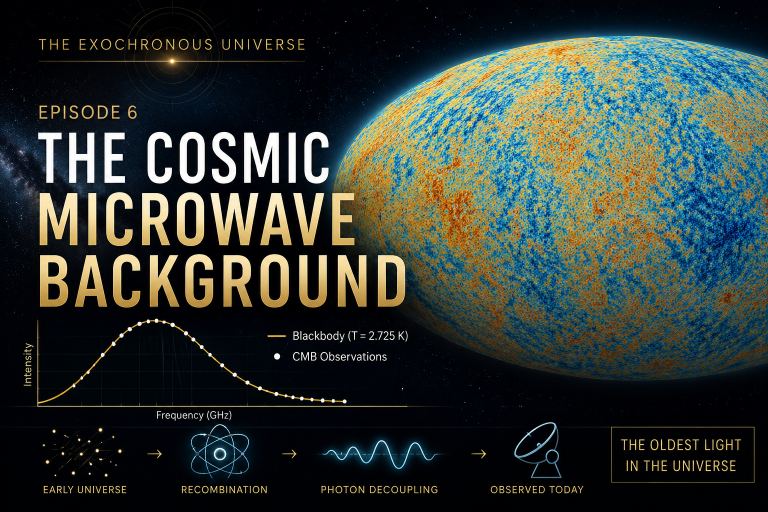
  • Episode 6 – The Cosmic Microwave Background

    The Cosmic Microwave Background is often described as the oldest light in the Universe. But what do we actually observe—and what do we infer from those observations?

    In this episode of The Exochronous Universe, we explore one of the most important discoveries in modern cosmology: the Cosmic Microwave Background (CMB).

    We begin with its accidental discovery in 1964 before examining the remarkable observations that have made the CMB one of the strongest pillars of the standard cosmological model. Along the way, we explain blackbody radiation, thermal equilibrium, recombination, photon decoupling, and the tiny temperature fluctuations that contain a wealth of information about the early Universe.

    Just as in the previous episodes, we carefully distinguish between observation and interpretation. The existence of the CMB, its near-perfect blackbody spectrum, and its minute anisotropies are directly measured. The physical history that produced those observations is reconstructed through cosmological models.

    Whether you are new to cosmology or already familiar with the subject, this episode provides a clear and balanced explanation of what the Cosmic Microwave Background is, why it is so important, and why it continues to play a central role in our understanding of the Universe.

    In this episode:

    • The accidental discovery of the Cosmic Microwave Background
    • What astronomers actually measure
    • Why the CMB has a near-perfect blackbody spectrum
    • Recombination and photon decoupling explained intuitively
    • Why the CMB comes from every direction in the sky
    • The tiny temperature anisotropies revealed by COBE, WMAP and Planck
    • What cosmologists learn from the CMB power spectrum
    • The crucial distinction between observation and interpretation

    This episode continues our journey through the foundations of modern cosmology, building towards future discussions of baryogenesis, primordial nucleosynthesis, dark matter, the physical origin of redshift, and the Jeans Contraction / Exochronous cosmological framework.


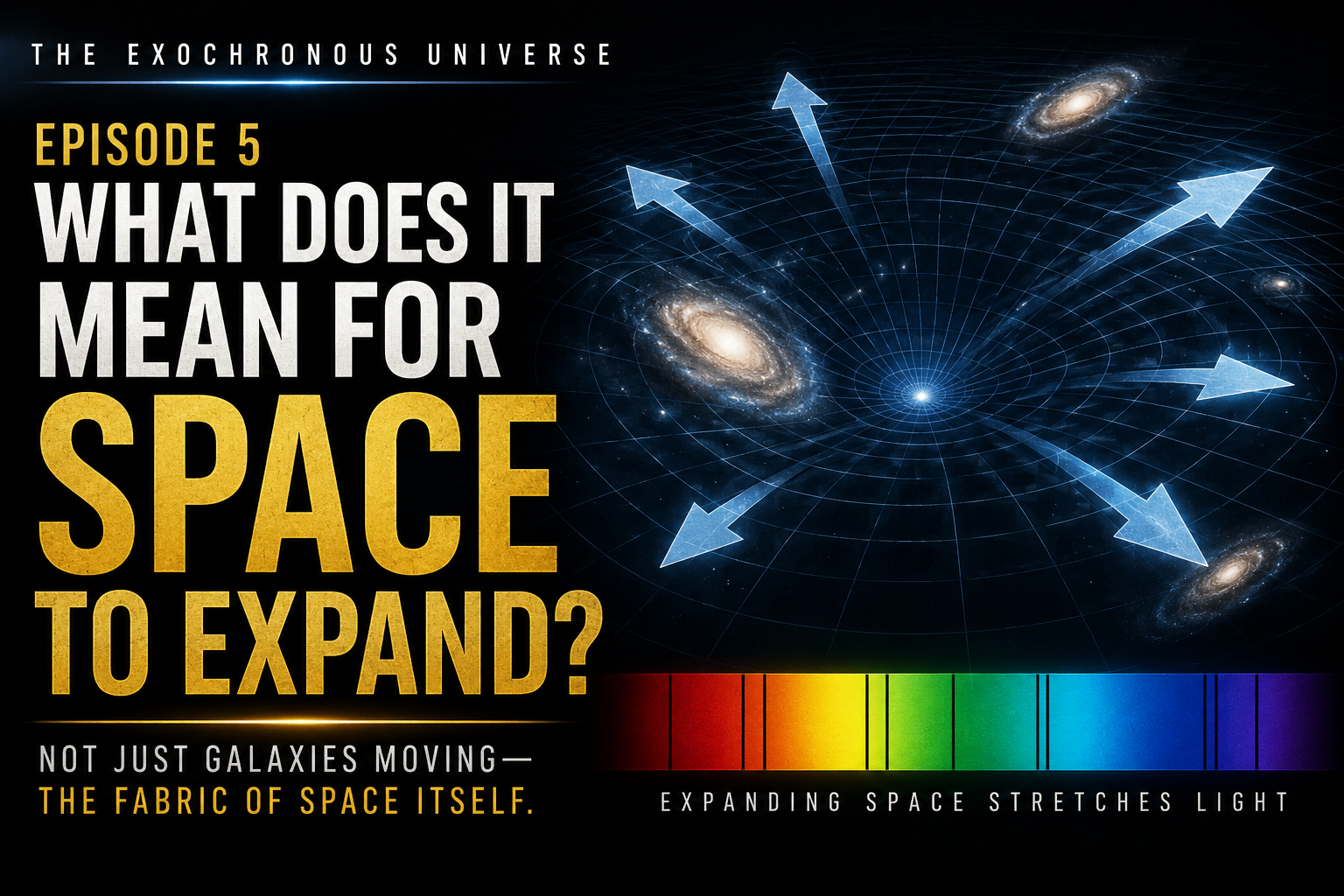
  • Episode 5 – What Does It Mean for Space to Expand?

    What does it actually mean to say that the Universe is expanding?

    Modern cosmology tells us that distant galaxies are receding from one another as space itself expands. But what does that statement really mean? Are galaxies moving through space, or is the geometry of space changing? Why can some galaxies appear to recede faster than light? And if space is expanding, why don’t stars, planets, or even atoms expand as well?

    In this episode of The Exochronous Universe, we explore one of the most fundamental—and often misunderstood—concepts in cosmology: the expansion of space.

    We’ll examine:

    • The difference between motion through space and expansion of space
    • The role of the cosmological scale factor • Comoving coordinates and cosmic geometry
    • Why distant galaxies can appear to recede faster than light
    • Why gravitationally bound structures do not participate in cosmic expansion
    • The strengths and limitations of common analogies such as the balloon, raisin bread, and rubber sheet models
    • The distinction between direct observation and geometric interpretation

    Along the way, we’ll revisit a recurring theme of this series: the difference between what astronomers directly observe and the theoretical frameworks used to interpret those observations.

    This episode does not advocate any particular cosmological model. Instead, it aims to clarify what modern cosmologists mean when they describe an expanding Universe—and to encourage careful thinking about the assumptions that underlie our interpretation of the cosmos.


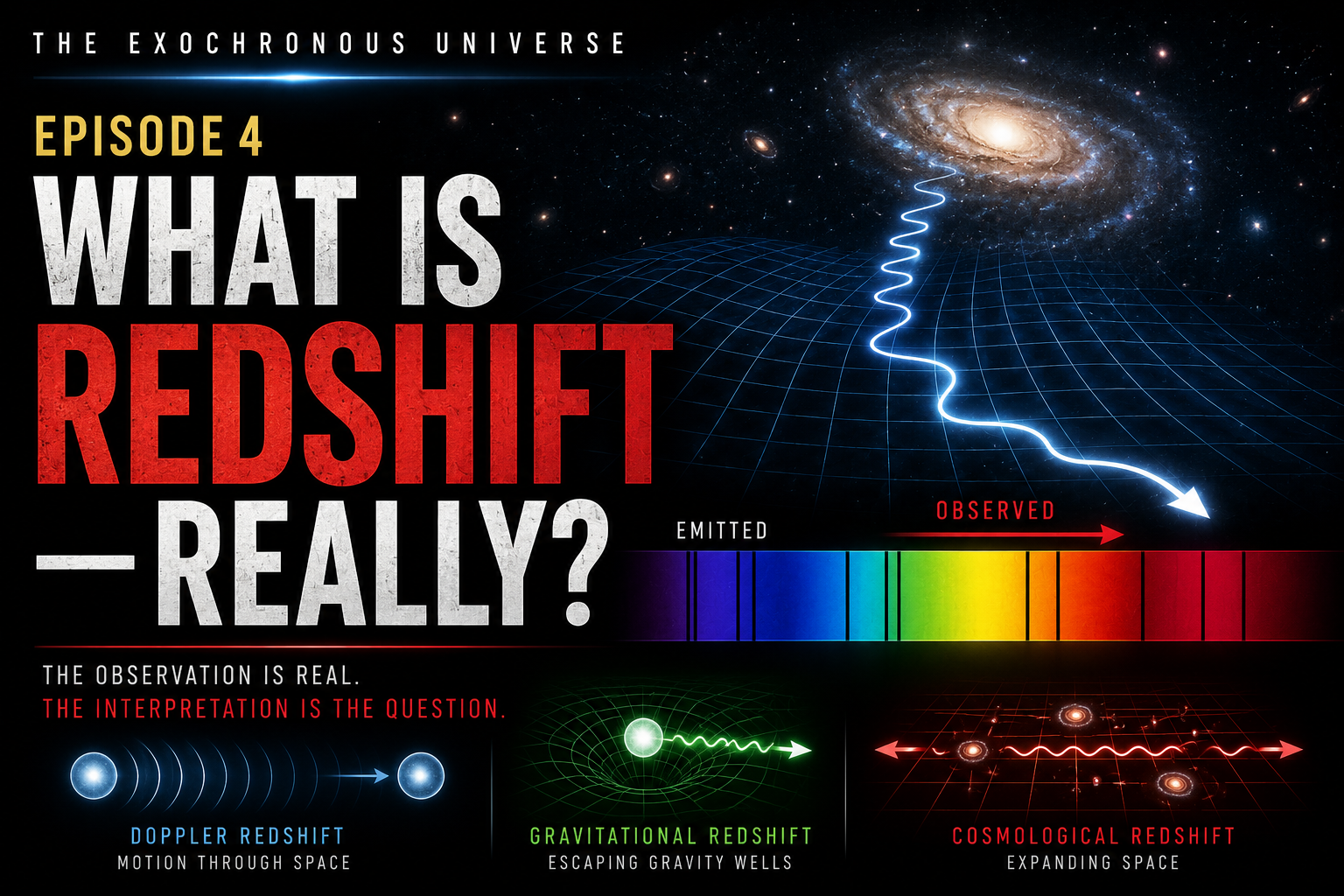
  • Episode 4 – What is Redshift – Really?

    For more than a century, cosmic redshift has been one of the foundational observations of modern cosmology.

    It underpins our understanding of an expanding universe, the Big Bang, and the history of cosmic evolution itself.

    But what exactly is redshift?

    What do astronomers actually measure when they observe distant galaxies? How are redshifts determined from spectral lines? And what is the difference between Doppler redshift, gravitational redshift, and cosmological redshift?

    In this episode of The Exochronous Universe, we explore the physics behind redshift, the history of its discovery, and the distinction between what is directly observed and how those observations are interpreted within cosmological models.

    Topics covered:

    • Spectroscopy and atomic spectral lines
    • Measuring astronomical redshift
    • Doppler redshift and relative motion
    • Gravitational redshift in General Relativity
    • Cosmological redshift and expanding space
    • Hubble’s discovery of the redshift–distance relationship
    • Observation versus interpretation in cosmology
    • Why redshift remains central to our understanding of the universe

    This episode does not argue for or against any particular cosmological model. Instead, it examines one of astronomy’s most important observations and asks a simple question:

    What is redshift really telling us?


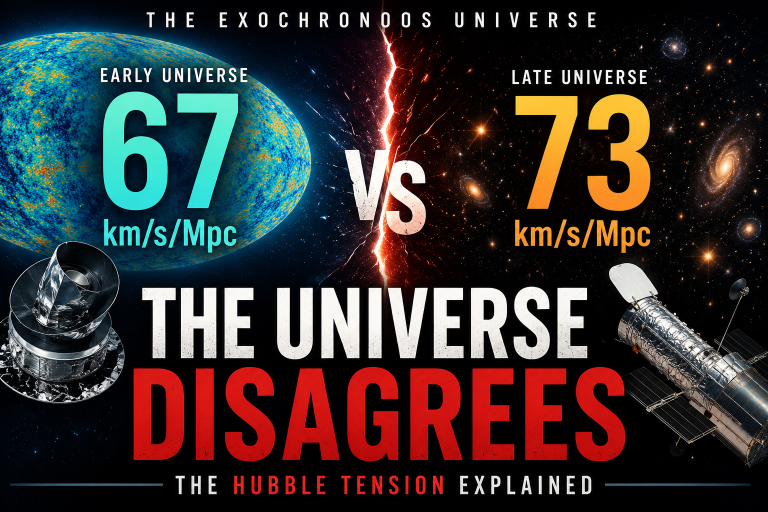
  • Episode 3 – The Hubble Tension Explained

    The Universe appears to disagree with itself.

    Using observations of the early Universe, cosmologists derive one value for the Hubble constant — the rate at which the cosmos is expanding today.

    But measurements based on nearby galaxies give a different answer.

    This growing discrepancy, known as the Hubble tension, has become one of the most significant unresolved problems in modern cosmology.

    In this episode, we explore:

    • What the Hubble constant actually measures
    • How astronomers use redshift to infer cosmic expansion
    • Why measurements from the Cosmic Microwave Background differ from direct observations of galaxies
    • How primordial sound waves in the early Universe influence modern cosmological models
    • And why the tension may point toward deeper questions about the nature of cosmic measurement itself

    Rather than offering easy answers, this episode examines the assumptions underlying modern cosmology — and asks whether the disagreement could reflect something more fundamental about how we interpret the Universe.