
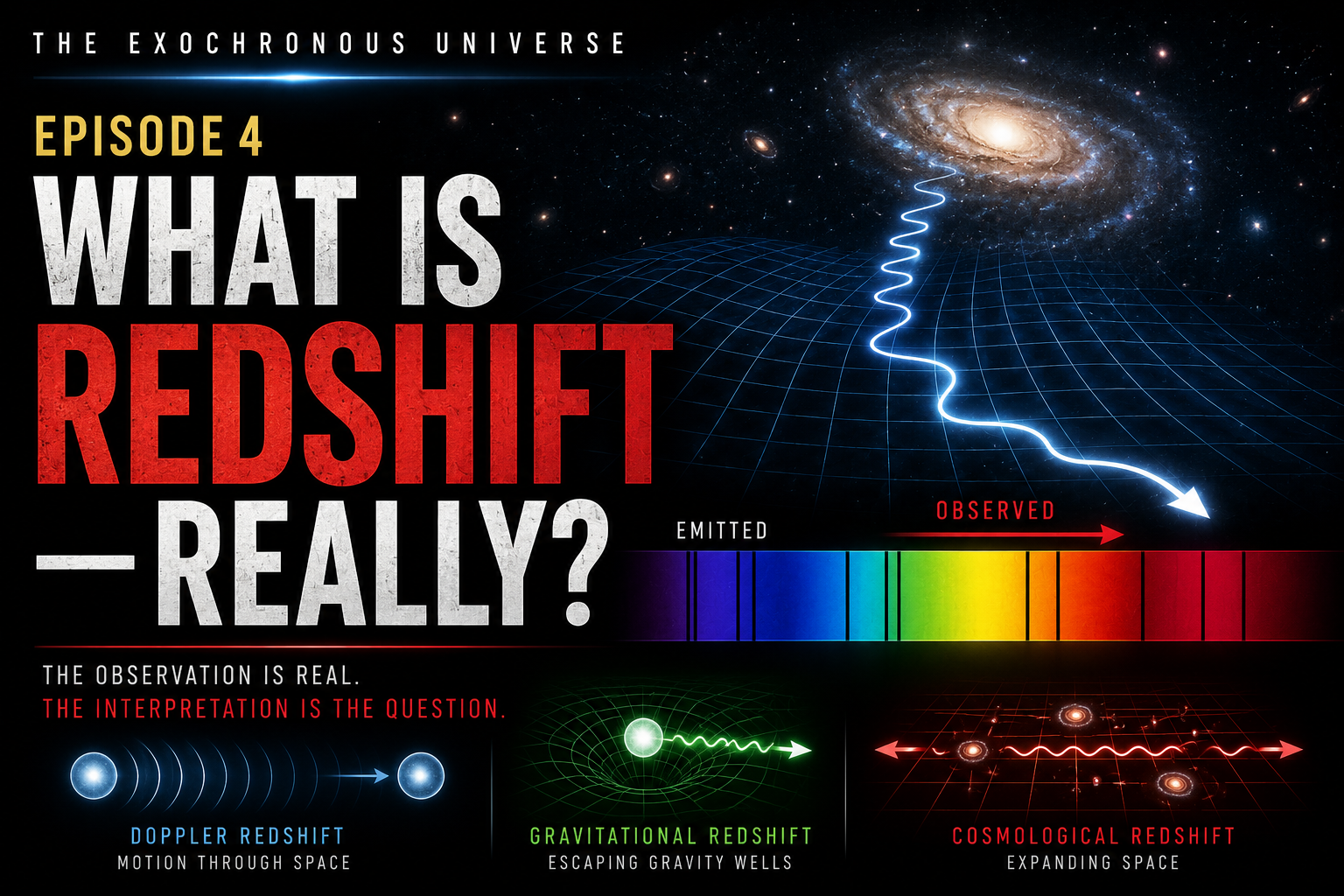
For more than a century, cosmic redshift has been one of the foundational observations of modern cosmology.
It underpins our understanding of an expanding universe, the Big Bang, and the history of cosmic evolution itself.
But what exactly is redshift?
What do astronomers actually measure when they observe distant galaxies? How are redshifts determined from spectral lines? And what is the difference between Doppler redshift, gravitational redshift, and cosmological redshift?
In this episode of The Exochronous Universe, we explore the physics behind redshift, the history of its discovery, and the distinction between what is directly observed and how those observations are interpreted within cosmological models.
Topics covered:
- Spectroscopy and atomic spectral lines
- Measuring astronomical redshift
- Doppler redshift and relative motion
- Gravitational redshift in General Relativity
- Cosmological redshift and expanding space
- Hubble’s discovery of the redshift–distance relationship
- Observation versus interpretation in cosmology
- Why redshift remains central to our understanding of the universe
This episode does not argue for or against any particular cosmological model. Instead, it examines one of astronomy’s most important observations and asks a simple question:
What is redshift really telling us?
Leave a Reply