
Abstract
We examine some of the consequences of the Exochronous (timeless) metric and the associ-
ated ΣGR cosmological model for the formation of galaxies, and, in particular, their characteristic
rotation curves. We show how the cumulative curvature from the multiple spatial hypersurfaces in
this model leads to a modified version of the Poisson equation, in which the gravitational potential
is computed over 4D space. Using this new form of the Poisson equation, we derive an analytic
expression for gravitational potential as a function of radial distance for a uniform gas cloud un-
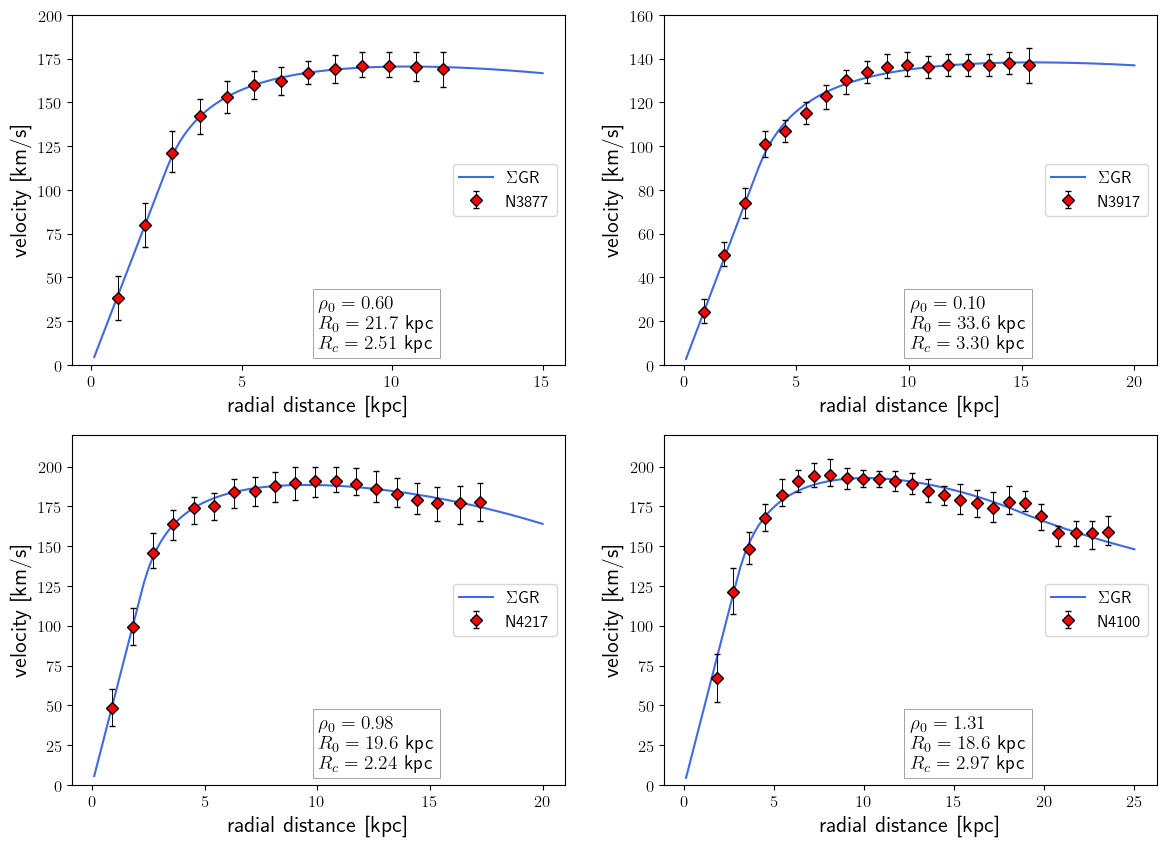
dergoing gravitational collapse. We show that this results in a radial velocity profile that provides
an excellent fit with commonly observed galaxy rotation curves, and hence fully accounts for the
effects previously ascribed to dark matter. An expression can be derived for the equivalent matter
density profile corresponding to the ΣGR gravitational potential, from which it is evident that this
is very similar in form to the well-known Navarro–Frenk–White profile. As a further illustration
of the consequences of adopting the Exochronous metric, we show how the principle can readily
be incorporated into particle-mesh N-body simulations of large-scale structure evolution, using
a relaxation solver for the solution to the Poisson equation and the evolution of the gravitational
potential. Examples of the use of this simulation model are shown for the following cases: (a) the
initial evolution of a large-scale structure, and (b) galaxy formation from a gravitationally collapsing
gas cloud. In both cases, it is possible to directly visualise the build-up of the gravitational potential
in 3D space as the simulation evolves and note how this corresponds to what is currently assumed to
be dark matter.
Full Text
https://www.mdpi.com/2075-4434/12/3/21
Leave a Reply