
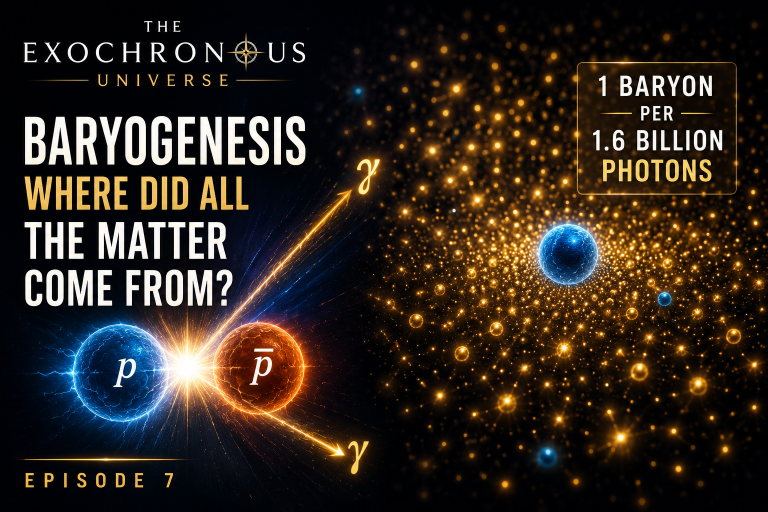
Everything around us—every star, every planet, every living thing—is made from ordinary matter. But according to modern particle physics, the extremely hot conditions believed to have existed in the early Universe should have produced matter and antimatter in almost equal quantities. If so, why wasn’t everything annihilated? In this episode, we explore one of the deepest unsolved problems in modern cosmology: baryogenesis—the origin of the tiny excess of matter that allowed galaxies, stars, planets, and ultimately ourselves to exist.
We’ll examine:
• Why physicists expect matter and antimatter to have been produced together.
• How matter and antimatter annihilate.
• The tiny baryon asymmetry observed in our Universe.
• The baryon-to-photon ratio and how it is measured.
• The Sakharov conditions for generating a matter excess.
• Electroweak baryogenesis, Grand Unified Theory baryogenesis, and leptogenesis.
• Why none of these proposed mechanisms has yet been experimentally confirmed.
Throughout the episode we distinguish carefully between:
• Direct astronomical observations.
• Experimentally established particle physics.
• Theoretical requirements.
• Speculative mechanisms that remain active areas of research
Baryogenesis is not a failure of modern cosmology. Rather, it is one of the major unanswered questions at the frontier of contemporary physics. Whatever cosmological model ultimately proves correct, it must explain why our Universe contains matter at all. This episode continues our journey through the observational foundations of cosmology while laying the groundwork for future episodes on primordial nucleosynthesis, dark matter, cosmological redshift, and the physical mechanisms that may underlie the evolution of the Universe.
Leave a Reply