
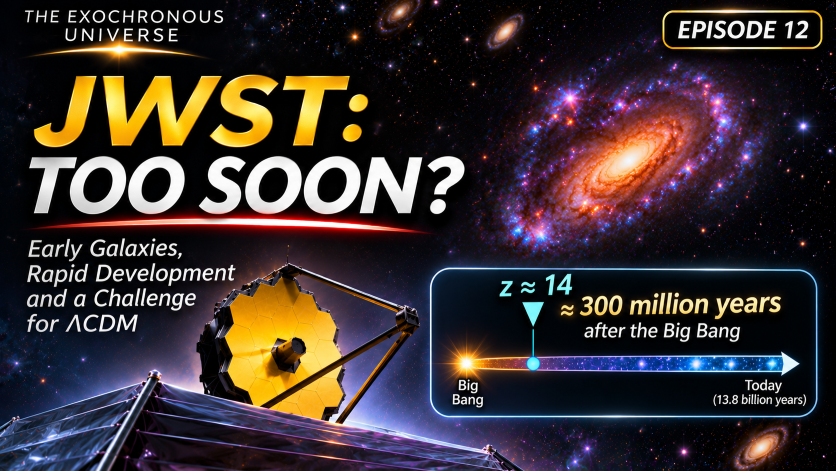
The James Webb Space Telescope is revealing galaxies that appear remarkably luminous, chemically enriched and developed just a few hundred million years after the Big Bang.
Did the early Universe really have enough time to produce them?
In Episode 12 of The Exochronous Universe, we bring together some of the most significant unresolved questions in modern cosmology — from the Hubble tension and the mysteries of dark matter and dark energy to the extraordinary discoveries emerging from JWST.
We also investigate a less widely discussed observation: the relationship between galaxy angular size and redshift.
Using data from six independent JWST survey fields, we examine how the inferred physical sizes of distant galaxies depend on the cosmological distance model used to interpret their observations.
Under the standard ΛCDM model, our analysis finds that inferred galaxy half-light radii decrease approximately as (1+z)⁻¹ at redshifts greater than two. An alternative static-universe distance prescription produces a much flatter size evolution.
Does this mean the Universe is not expanding? Not necessarily. Galaxies evolve, and their observed sizes are affected by selection effects and instrumental limitations. But the comparison illustrates an important distinction between what astronomers actually measure and what cosmological models allow us to infer.
In this episode:
- Why the Hubble tension remains unresolved.
- What JWST is revealing about early galaxies, chemical enrichment and supermassive black holes.
- Why early galaxy formation presents challenges for conventional astrophysical models.
- How astronomers measure the apparent sizes of distant galaxies.
- What our independent analysis of six JWST survey fields reveals.
- Why inferred galaxy sizes and cosmic ages depend on cosmological assumptions.
- Whether alternative interpretations of cosmological redshift deserve further investigation.
ΛCDM remains a remarkably successful framework, accounting for the cosmic microwave background, large-scale structure and many other observations. The questions explored here do not invalidate those achievements.
But they invite us to reconsider the distinction between observation, mathematical description and physical explanation.
What if cosmological redshift has an explanation beyond the expansion of space?
That is the question we will begin exploring in Episode 13:
What If the Universe Isn’t Expanding? — Jeans Contraction and the Origin of Cosmological Redshift.
Scientific references
- Planck Collaboration (2020). Planck 2018 Results. VI. Cosmological Parameters. Astronomy & Astrophysics.
https://doi.org/10.1051/0004-6361/201833910 - Riess et al. (2022). A Comprehensive Measurement of the Local Value of the Hubble Constant. Astrophysical Journal Letters.
https://doi.org/10.3847/2041-8213/ac5c5b - Carniani et al. (2024). A shining cosmic dawn: spectroscopic confirmation of two luminous galaxies at z ~ 14. Nature.
https://doi.org/10.1038/s41586-024-07860-9 - Schouws et al. (2025). The surprisingly mature galaxy JADES-GS-z14-0 at redshift 14.18. Nature.
https://doi.org/10.1038/s41586-024-08402-5 - Lovyagin et al. (2022). Cosmological Model Tests with JWST. Galaxies, 10, 108.
https://doi.org/10.3390/galaxies10060108 - Raikov, Tsymbal & Lovyagin (2025). Cosmological Observational Tests in the JWST Era. I: Angular Size–Redshift. Astrophysical Bulletin.
https://doi.org/10.1134/S1990341325600383
Galaxy-size analysis: Independent examination of spectroscopically confirmed galaxies from six ASTRODEEP-JWST survey fields (CEERS, Abell 2744, PRIMER-UDS, PRIMER-COSMOS, JADES-GS and JADES-GN). The full selected catalogue contains 7,056 galaxies; size-evolution fits use the subset at z > 2.
ASTRODEEP-JWST catalogues:
http://www.astrodeep.eu/astrodeep-jwst-catalogs/
Join the discussion
Do JWST’s discoveries primarily challenge our models of early galaxy formation, or should we also reconsider some of the cosmological assumptions used to interpret them?
Comments and scientifically grounded alternative perspectives are welcome.
Subscribe to The Exochronous Universe for the next episode, where we begin exploring Jeans Contraction as a possible alternative explanation for cosmological redshift.
#JWST #Cosmology #LambdaCDM #JamesWebbSpaceTelescope #HubbleTension #Redshift #ExochronousUniverse
Leave a Reply